How to make a ruyi knot and its significance
如意结
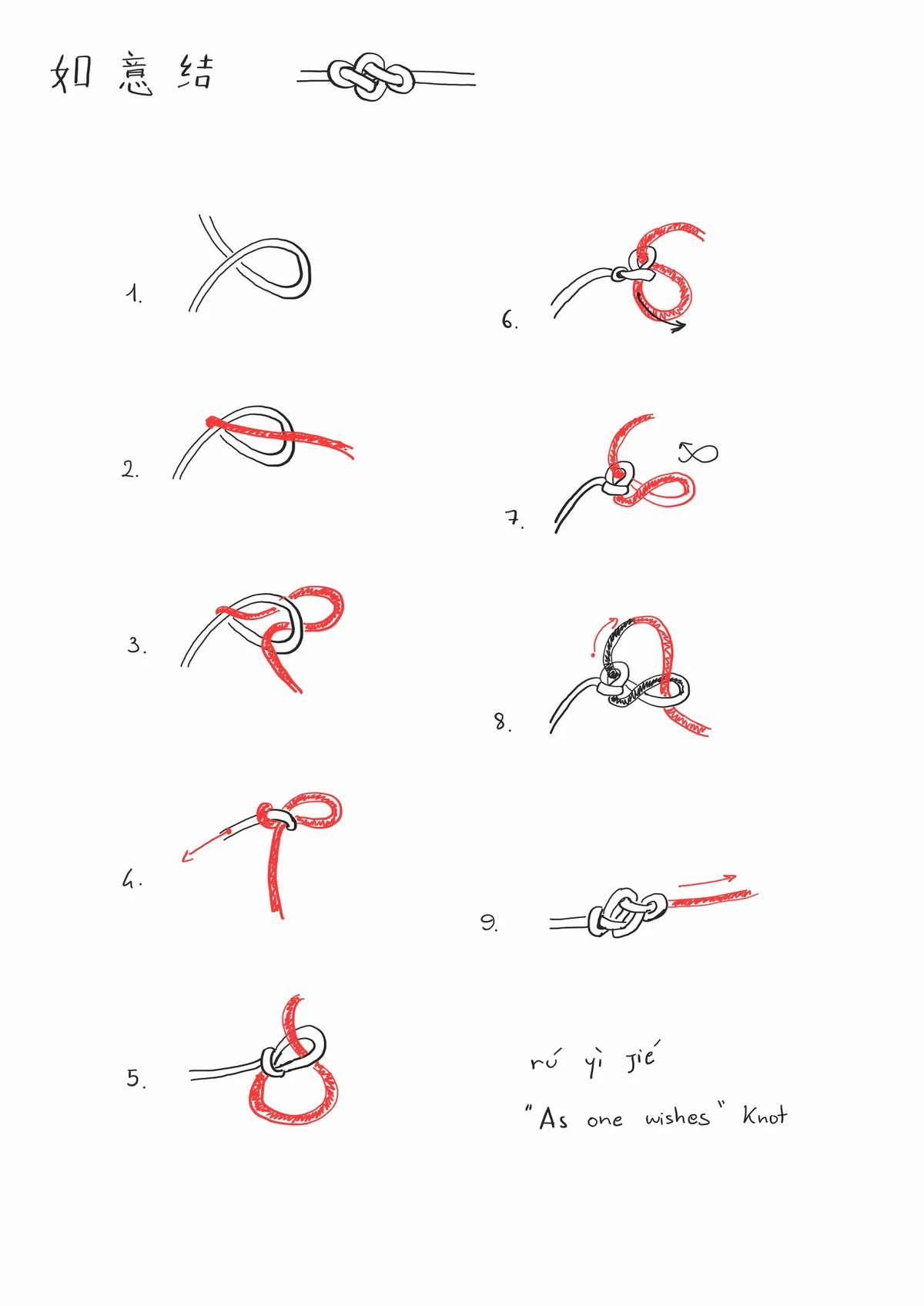
Last summer I made a gift that required a decorative knot. I had already tied some "good luck knots", but I was searching for something different, a little more subtle but still decorative, and that hanged straight. I remember I found a video explaining various Chinese knots and, amidst them, there was one called ruyi knot that I thought was exactly what I was searching for. It is not a complex knot, but I think it is pretty in its simplicity. Differently from the good luck knot, it continues along the strand of cord, instead of splitting it in two ends.
For some reason, there are not as many tutorials for this particular knot as there are for others; and when you search it by its name, other knots appear. So I am not even sure this is its correct or more known name. Anyway, for these reasons I decided to try and draw a step-by-step guide for myself, which is the image above. I wonder if at the eyes of others the tutorial is easy to follow, because looking at it after some months have passed I do think is simple enough to understand, but I was the one who drew it so it doesn't really count.
Ruyi 如意 means "as desired", "as you wish" and is the name of an important decorative object in Chinese culture; a scepter or a talisman of good fortune. So, images inspired by it appear frequently as motifs in art, including knotting. While researching the knot, I've found all the connections to subjects I've studied in university, and I'm sure it will appear again in the future and I will think "ah, like the knot!". Exactly as it happened when I was buying a good fortune pendent and it read "万事如意" (wànshì rúyì) a common phrase of well-wishes that translates to "may all your wishes be fulfilled".